

Your starting point
Disable the slots the recipe does not use, feed only its specified ingredient and generate pulses once all nine slots are occupied or disabled. Our Java 26.3 layout uses a clock and a conservative chest stop at signal 14; change the grid and keep ingredients separate.
In this guide
Choose one of five recipes
The slot numbers and quantities refer to the modules described here. Each row needs its own configured crafter; changing products requires emptying the input, hopper and crafting grid first.
| Product | Per craft | Enabled | Disabled |
|---|---|---|---|
| Bamboo blocks | 9 bamboo → 1 block | 1–9 | — |
| Bamboo sticks | 2 bamboo → 1 stick | 1, 4 | 2, 3, 5, 6, 7, 8, 9 |
| Paper | 3 sugar cane → 3 paper | 1, 2, 3 | 4, 5, 6, 7, 8, 9 |
| Bone meal | 1 bone → 3 bone meal | 1 | 2–9 |
| Bone blocks | 9 bone meal → 1 block | 1–9 | — |
Number the grid before disabling slots
Look at the interface: the first row is 1, 2, 3; the second is 4, 5, 6; the third is 7, 8, 9. Empty a slot and click it while holding no items to disable it. Check the grey marks before adding ingredients.
A disabled slot counts toward the comparator reading, just like an occupied slot. The circuit’s reference of 8 allows a signal once the total reaches 9. That reading does not identify the ingredient you supplied: mixed input can prevent the intended recipe.
| Left | Center | Right |
|---|---|---|
| 1 | 2 | 3 |
| 4 | 5 | 6 |
| 7 | 8 | 9 |
Build the automatic circuit
Coordinates are relative to the crafter: X increases eastward and Z southward. Use a solid 17 × 14 base, X −5 through 11 and Z −5 through 8. The crafter and circuit share one height; the hopper goes above the crafter and the input chest above the hopper. This roomy plan makes the connections easier to inspect.
Arrows show signal output. C− is a subtract comparator with its front light on; C= is comparison mode. R1 and R4 mean one and four redstone ticks. Set an R4 with three right-clicks from its initial position.
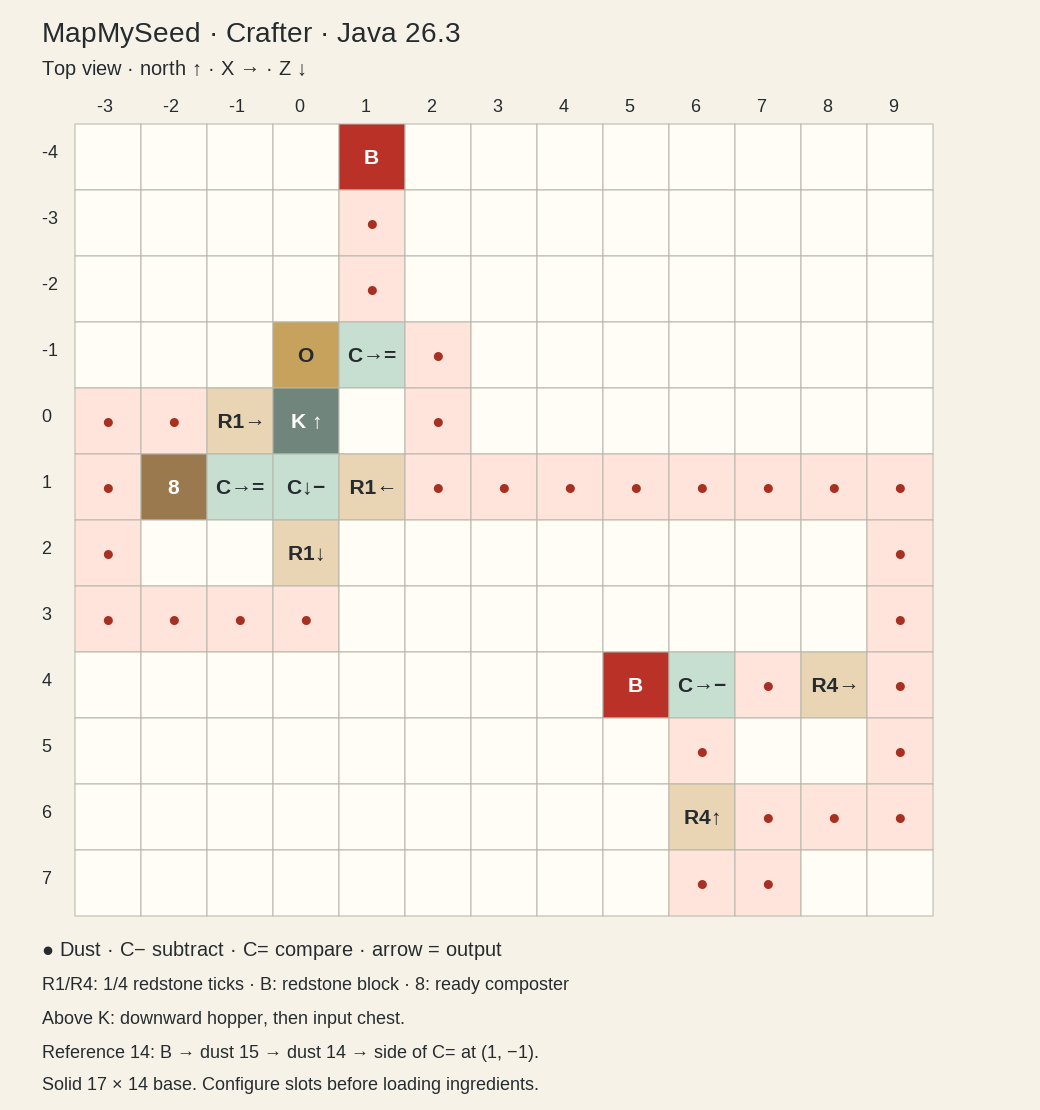
- Place K at (0, 0), facing north. Put the output chest at (0, −1), the downward hopper above K and the input chest above the hopper.
- Configure the recipe slots before loading ingredients. Dedicate the output chest to that product only.
- At (−2, 1), fill a composter until its compost is ready to collect and it emits 8. Leave the compost there. The comparator at (−1, 1) sends this reference into the side of the C− at (0, 1), which reads the crafter.
- Copy the southward path that returns to K’s west side, including its two R1 repeaters. Do not connect this path directly to the hopper.
- Build the clock on the right: C− at (6, 4), both R4 repeaters and the entire dust route, including the turn from (7, 7) to (6, 7). The R1 at (1, 1) feeds its pulses into the other side of the comparator reading K.
- Add the chest detector: C= at (1, −1), reading eastward, and its output via (2, −1) and (2, 0). Its north-side reference is 14: redstone block at (1, −4), dust at (1, −3), then dust at (1, −2). Do not put the block directly against the comparator.
- Place the clock’s redstone block at (5, 4) last. Check that its signal alternates, load only the correct ingredient and observe a small batch first.
Materials per module
This list covers one module, including our full base. You also need test ingredients and compostable items to prepare reference 8; that amount varies. It excludes access to an elevated platform and five copies of the circuit.
| Count | Component |
|---|---|
| 1 | Crafter |
| 1 | Downward-facing hopper |
| 2 | Single chests: input and output |
| 1 | Ready-to-collect composter, signal 8 |
| 4 | Comparators: two subtract, two compare |
| 5 | Repeaters: three at 1 tick and two at 4 redstone ticks |
| 31 | Redstone dust |
| 2 | Redstone blocks |
| 238 | Solid blocks for the 17 × 14 base |
Bamboo blocks
Leave all nine slots enabled. Feed only bamboo into this module. It compacts the material; it does not turn it into planks or sticks.
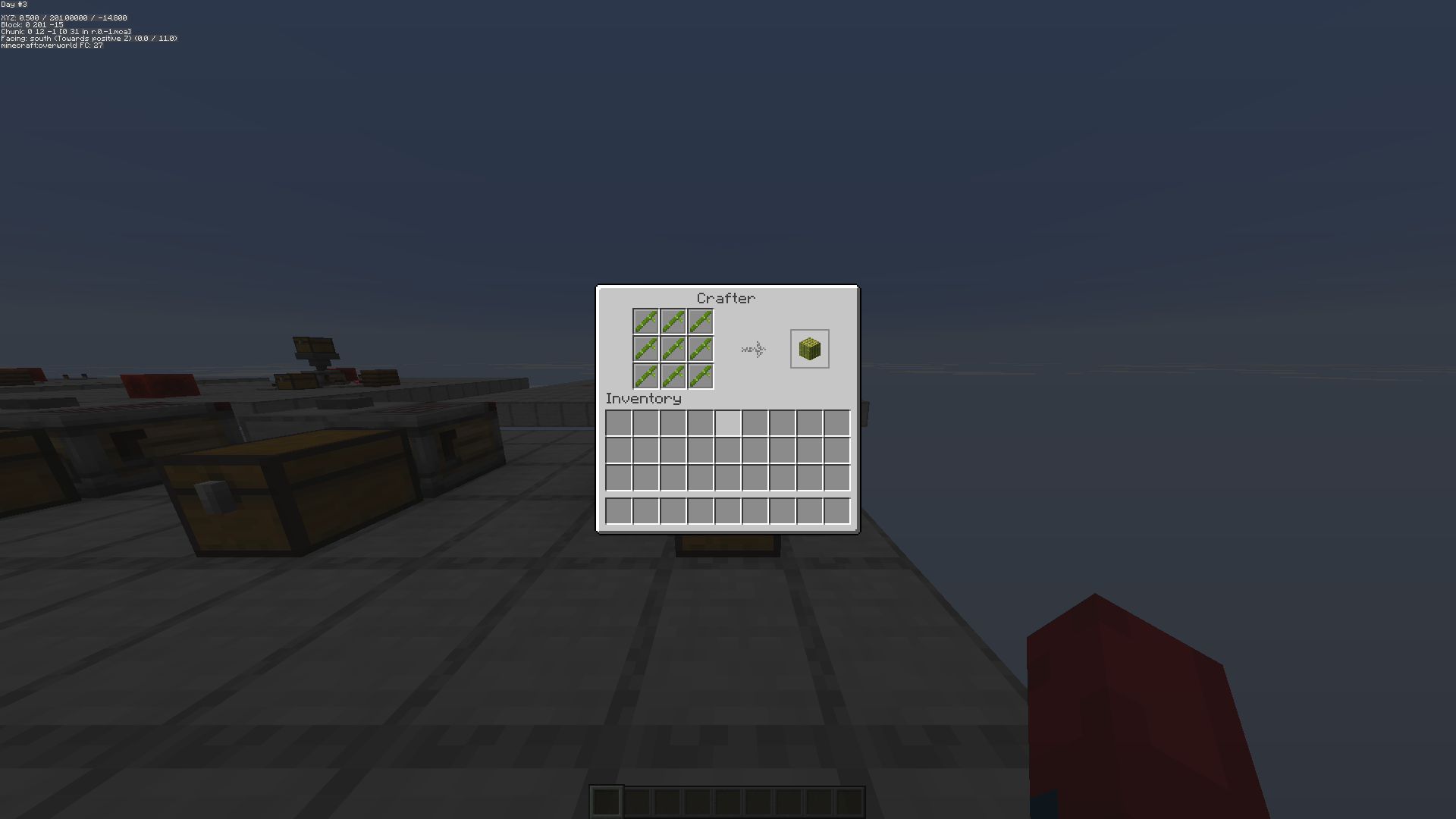
| Input | Collected output | Enabled slots |
|---|---|---|
| 144 bamboo | 16 bamboo blocks | 1–9 |
Bamboo sticks
Enable the top-left slot and the slot directly below it. Disable the other seven. This pair is vertical: two bamboo items side by side do not make this recipe. Do not confuse the result with the four sticks made from two planks.
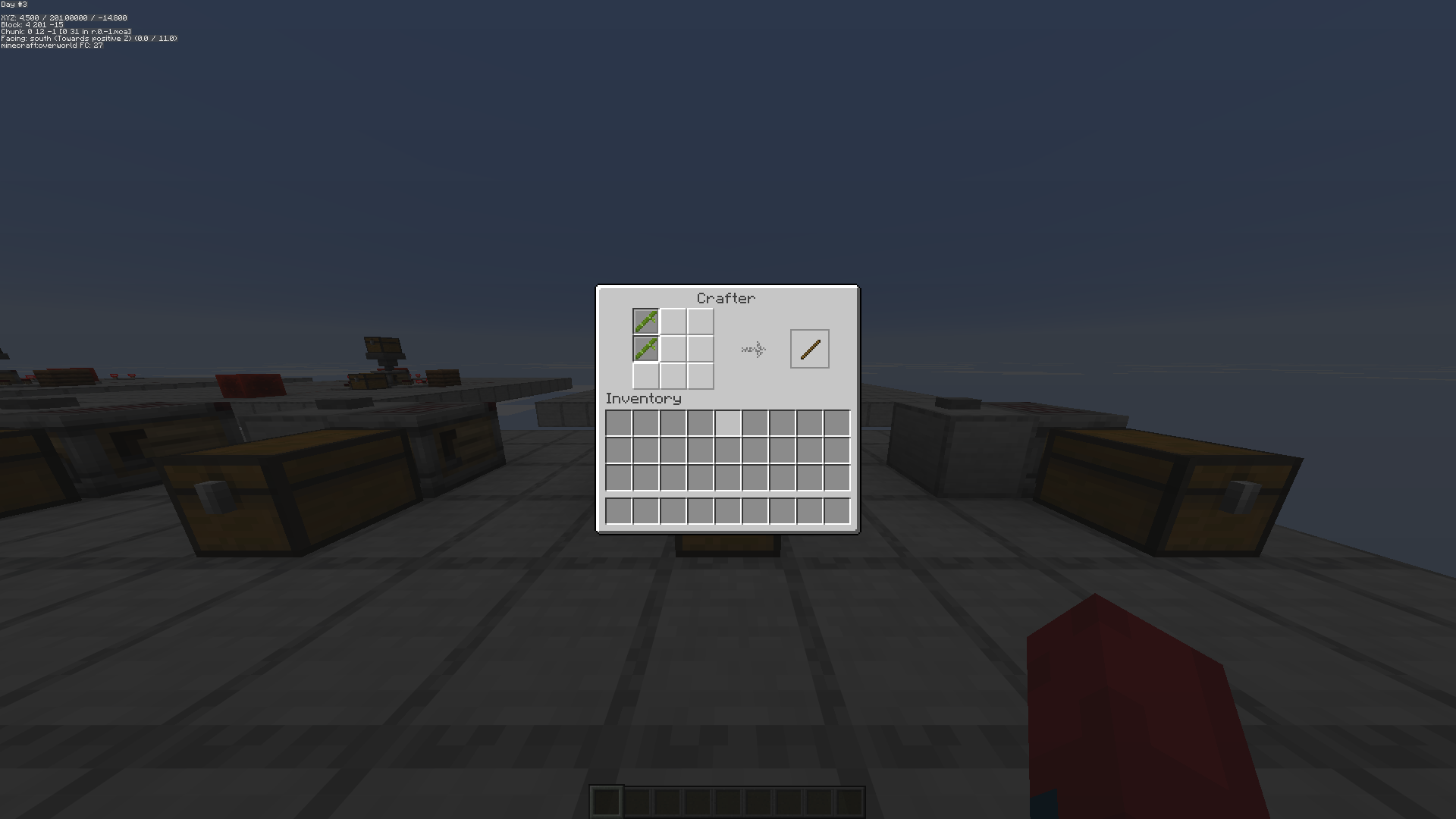
| Input | Collected output | Enabled slots |
|---|---|---|
| 32 bamboo | 16 sticks | 1, 4 |
Paper
Enable the entire top row and disable the other six slots. The hopper distributes sugar cane across that row. Each craft ejects three paper items; storage protection must leave room for all three.
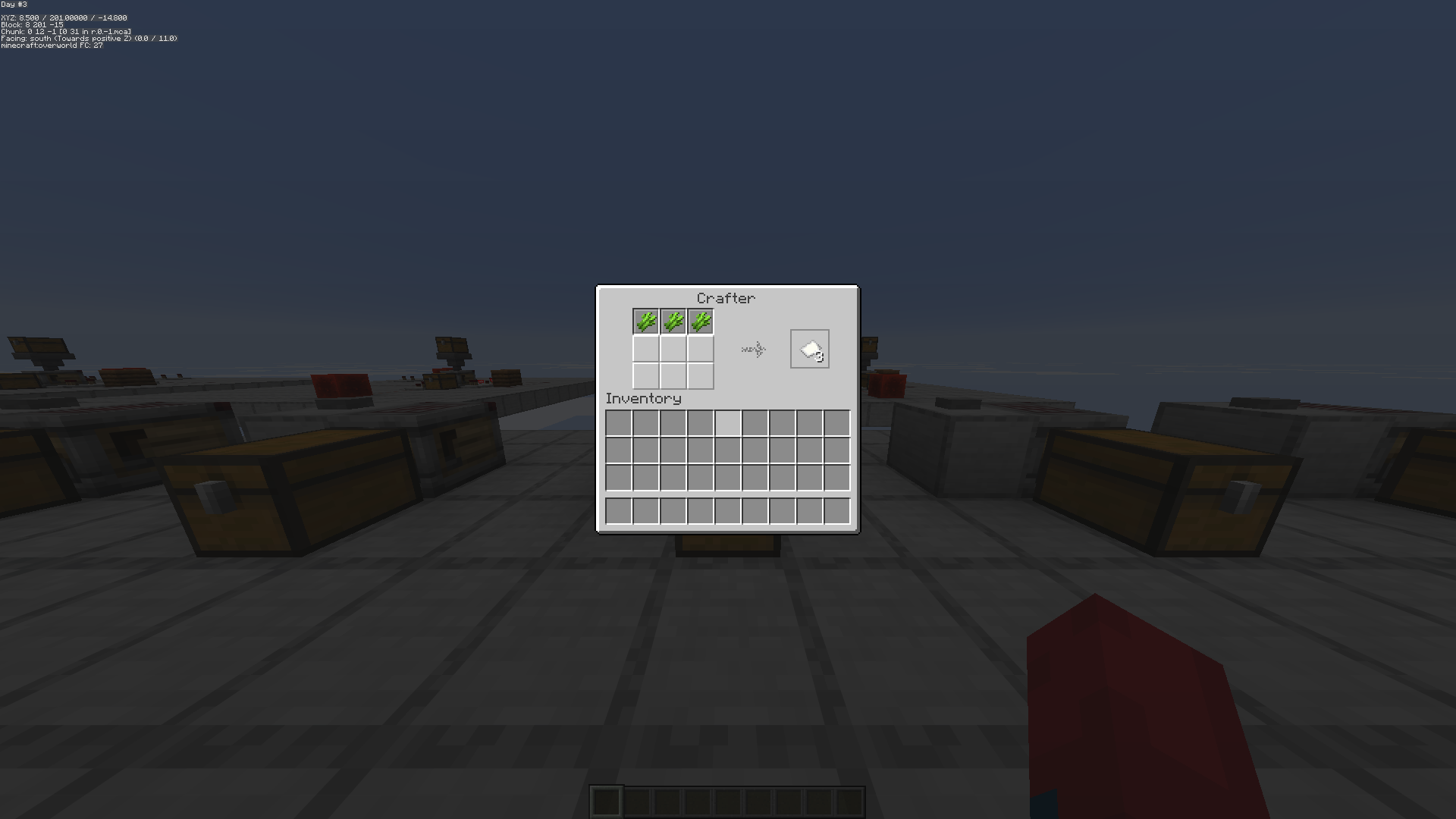
| Input | Collected output | Enabled slots |
|---|---|---|
| 48 sugar cane | 48 paper | 1, 2, 3 |
Bone meal
Leave only the top-left slot enabled. With the other eight disabled, one bone completes the recipe. When feeding a stack, the clock must keep generating pulses even while that slot remains occupied.
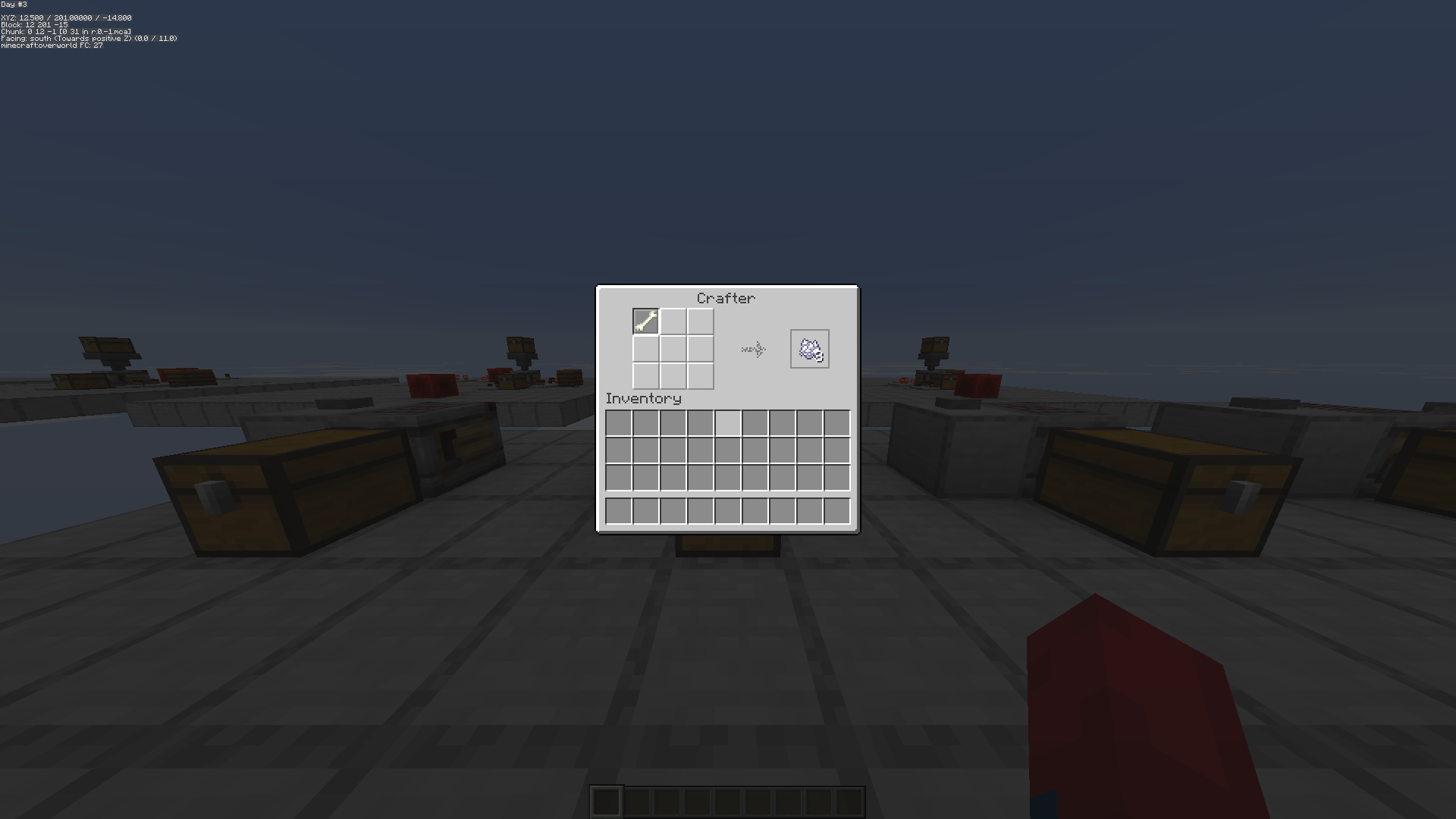
| Input | Collected output | Enabled slots |
|---|---|---|
| 16 bones | 48 bone meal | 1 |
Bone blocks
Enable all nine slots and feed only bone meal. This is a separate module: do not feed bones directly and expect blocks in one step. These tests use independent modules, not a chain of two crafters.
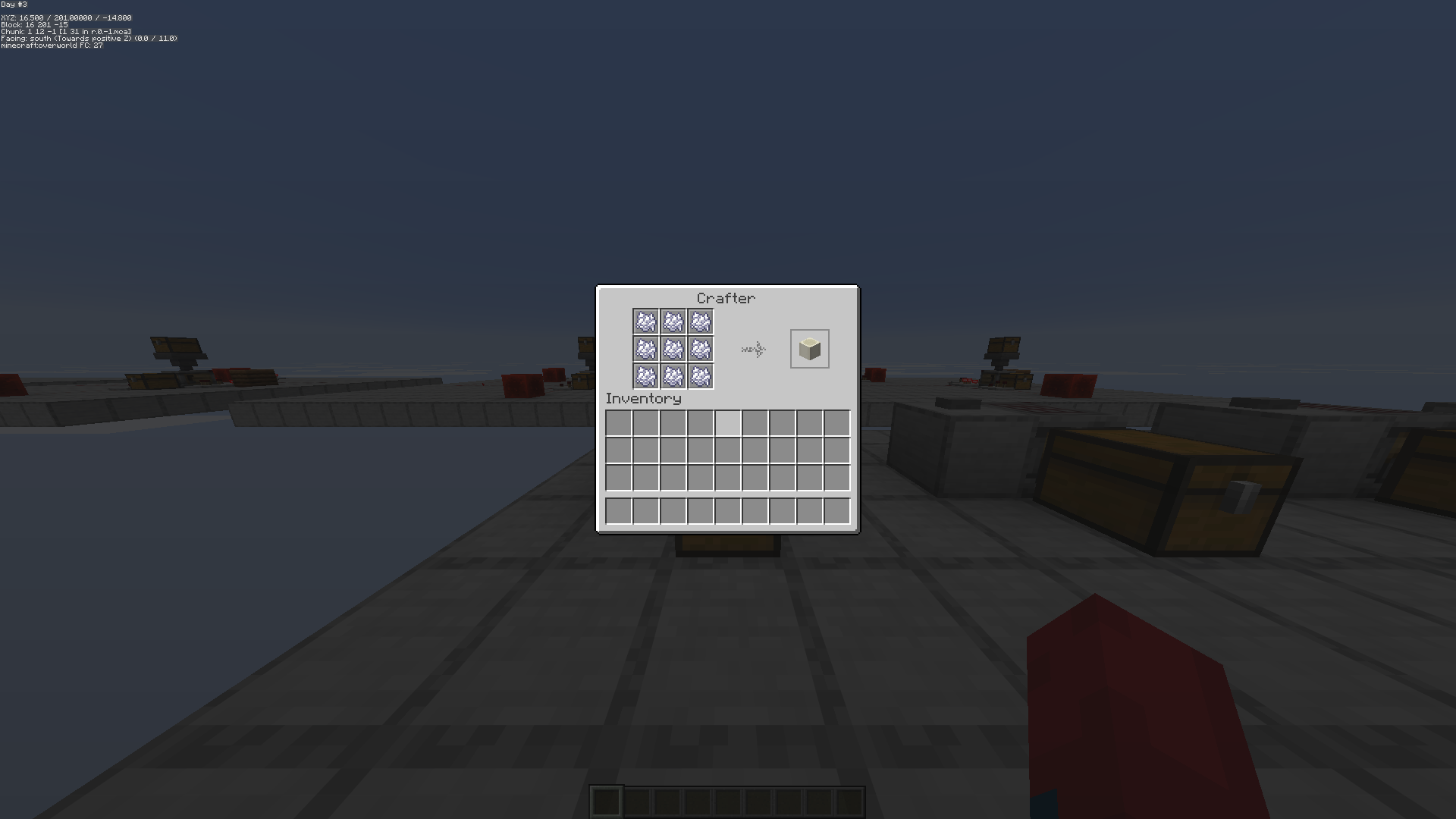
| Input | Collected output | Enabled slots |
|---|---|---|
| 144 bone meal | 16 bone blocks | 1–9 |
Why the chest stop uses reference 14
Waiting until the chest is completely full does not protect every output. In the reference-15 test, with room for only one item left, the paper and bone-meal recipes stored one and ejected two onto the ground. That variant is not the final plan.
The plan uses reference 14 and stops crafting earlier, leaving spare capacity in a product-only chest. It can therefore stop while you still see free space. Remove enough stored output for the chest signal to fall below 14; removing one item may not be enough.
Do not mix unrelated items into the output or substitute another container while assuming the same protection. This reserve is tested for the five listed recipes, whose results stack to 64; it is not a universal detector for every recipe.
What was checked in Java 26.3
On November 1, 2026, we tested all five modules in a new seed-1 superflat world using the official Java 26.3 client. Commands placed blocks and supplied ingredients; hoppers, clocks and crafters produced the outputs, without accelerated ticks or commands creating the results.
With the final plan, the 16-craft batches collected exactly the listed quantities, with no remaining ingredients or dropped products. We checked stopping with full and nearly full chests, then resuming after freeing three entire chest slots. After saving and reopening incomplete recipes, adding the remaining ingredient produced 1, 1, 3, 3 and 1 output items respectively.
We also checked interrupted input and two ingredients preloaded per enabled slot using the same clock; a separate bench confirmed every recipe with a physical button press. Laboratory chunks were force-loaded. This does not establish that a farm keeps working when its area stops being simulated.
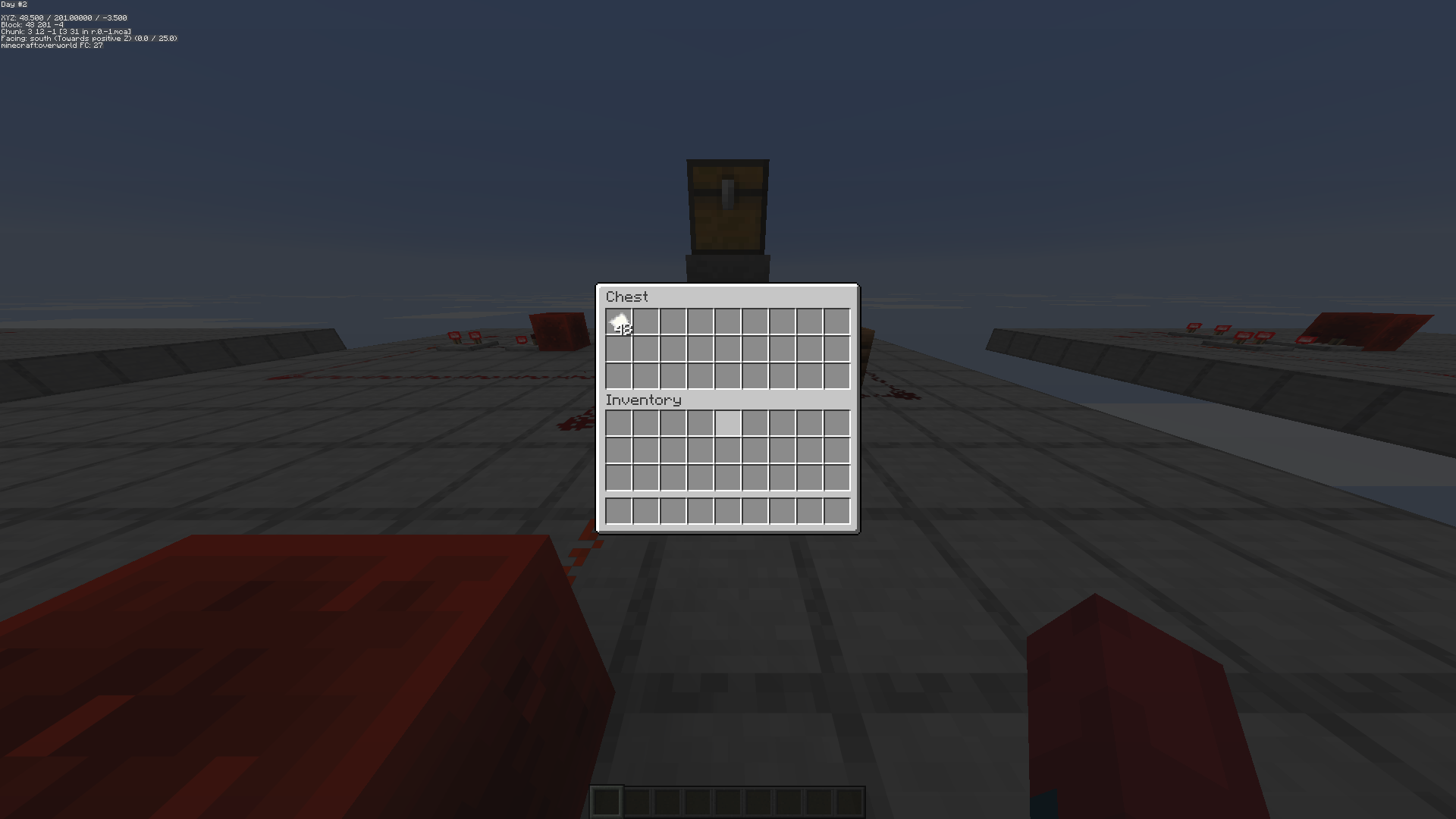
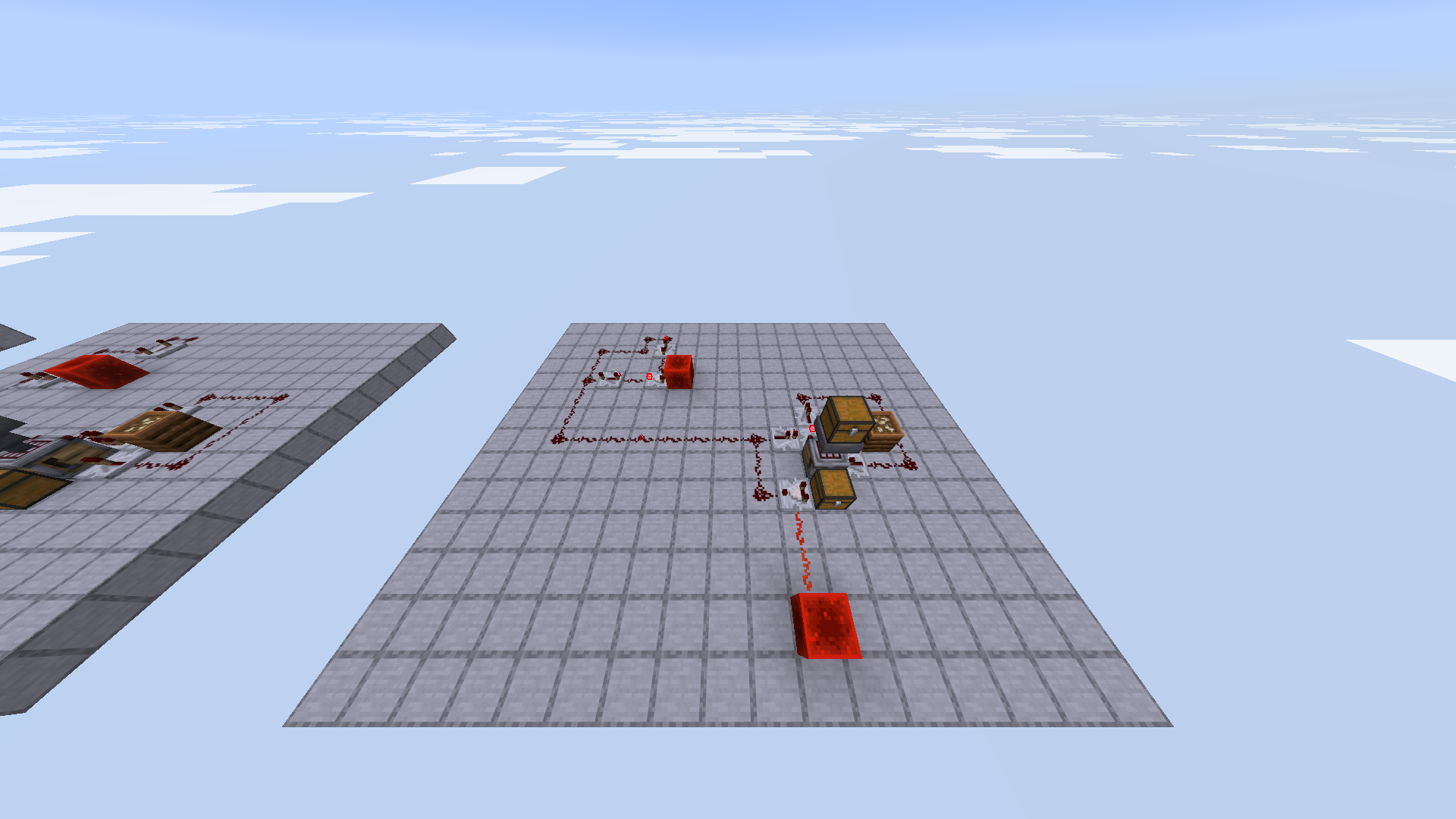
The actual laboratory build
The image shows one copy of the final circuit. The five automatic modules were separated to keep inputs and outputs distinct. Grid screenshots come from button controls using the same slot configurations.
If it stops or makes the wrong item
| Symptom | Check |
|---|---|
| Bamboo, but no sticks | Enable 1 and 4; disable the other seven. The pair is vertical. |
| Sugar cane, but no paper | Enable row 1–2–3; keep cane out of all other slots. |
| Bone meal, but no blocks | Enable all nine slots and feed bone meal, not bones. |
| A bone stays inside | Only slot 1 enabled; clock running and output chest below the stop threshold. |
| Crafts once, then stops | The circuit needs new pulses; steady power does not replace them. |
| Chest has space, but crafting stopped | The conservative stop can engage at signal 14. Remove enough output. |
| Items on the ground | Check output direction and reference 14; keep products separate and do not artificially fill the chest while running. |
Scope and next builds
The laboratory was built using commands. This makes its geometry reproducible, but does not measure the effort of gathering materials and building in Survival. Batches check operation; they are not hourly production claims. Bedrock, mods and chains between modules need separate tests.
For iron compaction, follow the tested iron-block build. For a paper ingredient supply, see the automatic sugar-cane guide.
Sources and review
Game information checked against the linked sources. Map steps were checked in this preview; its predictions remain experimental.